
Roof Moisture Survey Services.
Roof Moisture Survey Services support in New Orleans, LA, with documented inspections, written scopes, and practical roof planning for commercial properties.
What this roof work solves
Roof Moisture Survey Services in New Orleans should begin with a documented roof walk. The first job is to identify active water entry, drainage problems, membrane condition, edge details, rooftop equipment conflicts, and weather exposure before a price or schedule is discussed.
For commercial owners, the useful answer is rarely a one-line recommendation. The roof file should explain the work area, the reason for the scope, the access constraints, and the next maintenance decision.
How the scope is built
The scope is tuned to owner documentation, building use, roof age, visible defects, and the cost difference between immediate repair and longer-range planning. When repair is enough, the work stays focused. When replacement or recover planning is the responsible move, the reasoning is written plainly.
Each finished project should leave behind before-and-after photos, service notes, and follow-up items so the owner keeps a record for future inspections, budgeting, and vendor conversations.
Saturated insulation in New Orleans does not dry out between rain events. A roof that takes on moisture during a tropical storm in August is still wet in October — and still spreading. Core sampling is the only way to know how much of the insulation is wet and whether a recover is an honest scope.
The single most expensive mistake in commercial roofing is recovering a roof with wet insulation. A recover installs a new membrane over the existing system. In a dry climate, wet insulation might dry out over time even with the new membrane installed above it — slowly, through vapor drive, under warm dry conditions. In New Orleans, with annual rainfall above 60 inches, ambient relative humidity above 80 percent for months at a time, and dew points above 75°F from June through September, that moisture does not go anywhere. It stays in the insulation. The trapped moisture continues to degrade the polyiso or perlite below the new membrane, accelerates corrosion on light-gauge metal decks, and builds the mold and air-quality risk that is a specific concern in Louisiana's humid climate. Five years after the recover, the building needs a full tear-off of the new membrane, the old membrane, the damaged insulation, and possibly the deck — a project that costs two to three times what a full replacement would have cost at the original decision point.
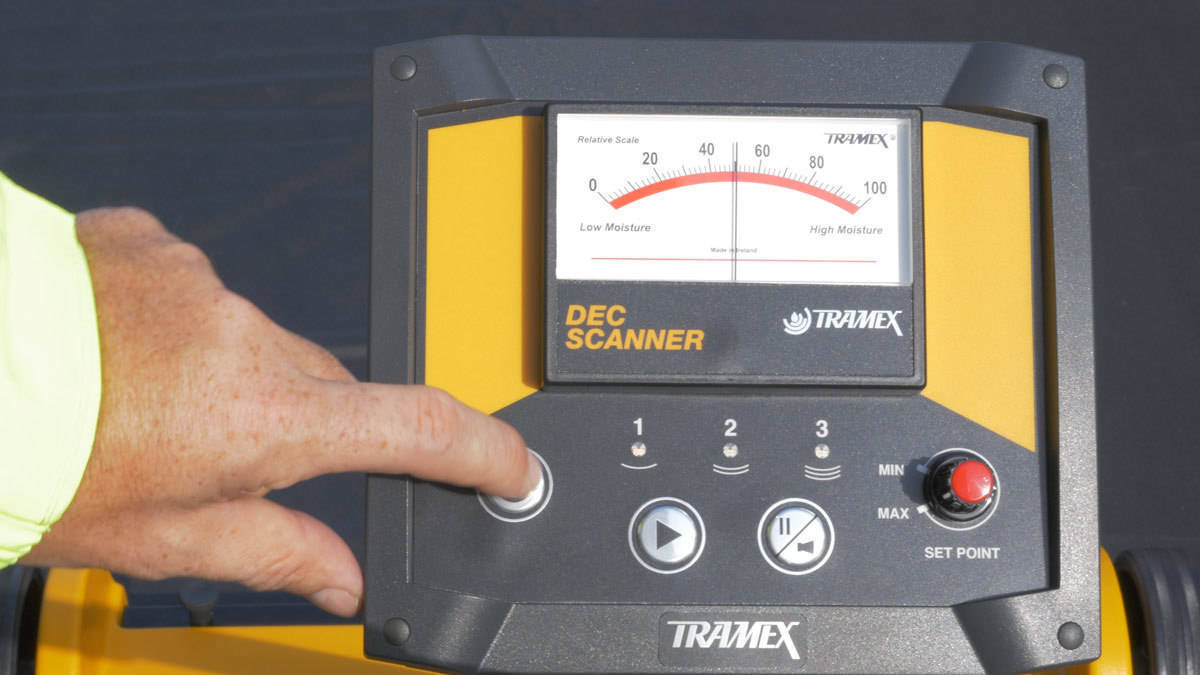
Moisture survey is the diagnostic tool that makes the recover-versus-replace decision supportable with data instead of assumption. We core-sample roofs to pull physical evidence of insulation condition at representative locations. We map the distribution of wet, damp, and dry zones to understand the percentage of the roof area affected and the spatial pattern — which tells us whether moisture is from a single discrete source or from diffuse multi-point infiltration across years of storm seasons.
The New Orleans market produces specific moisture patterns driven by how the building stock was constructed and how it has been maintained through the post-Katrina period. Rapid post-storm construction from 2006 through 2012 that prioritized speed over detail — drain flashings installed to minimum code, penetration sealing done in humid summer conditions that compromised bond quality — created a generation of commercial buildings now showing moisture in concentrated zones around drains and at parapet bases. Knowing these patterns guides where we sample first for statistical confidence.
Core Sampling Protocol in a High-Humidity Market
We pull cores with a 4-inch diameter core cutter at representative locations identified before the site visit by reviewing the existing inspection record, drain layout, storm history, and building vintage. Each core pulls through the membrane and the full insulation stack to the deck surface. We record the membrane condition, the insulation type and thickness, the condition of each layer, and whether the insulation is wet, damp, or dry by direct physical assessment at the core face.
In New Orleans's climate, the distinction between wet and damp is important: damp insulation — insulation with elevated moisture content but no standing water — can sometimes be recovered under controlled conditions if the area is limited and the deck is sound. Wet insulation — insulation with free water present at the core face, or insulation that is fully saturated and compressible — is a recover disqualifier. We document both categories separately on the moisture map rather than binning them together.
Core density is sized to produce statistical confidence for the decision at hand. On a 50,000 square foot building with no prior moisture data, we pull a minimum of 15 to 20 cores in a grid pattern plus targeted cores at high-probability locations — drains, parapet corners, penetration clusters, and any zones where prior inspections noted membrane tenting or soft substrate. Each core location is repaired with membrane-matching material and resealed before we leave the site. Core locations are logged on the zone diagram by number for future inspection reference.
Moisture Distribution Mapping and the 25-Percent Threshold
Core results are plotted on the zone diagram to produce a moisture distribution map. Wet cores, damp cores, and dry cores are marked distinctly and the spatial pattern is analyzed. Clustered moisture around drain perimeters and parapet bases — the most common pattern in post-Katrina New Orleans construction — indicates discrete infiltration sources that may have been present for multiple storm seasons. Dispersed moisture across a broad field area suggests systemic saturation from diffuse infiltration over years.
The 25-percent threshold is the conventional recover-versus-replace decision point: if more than 25 percent of the roof area has wet or significantly damp insulation, recovering is not an honest scope in any climate. In New Orleans, the subtropical humidity makes the threshold more consequential. A roof recovered over 20 percent wet insulation in New Orleans might dry to 10 percent over two dry winters. A roof recovered over 20 percent wet insulation in New Orleans will be at 30 percent wet by year three, because the moisture never leaves. We apply the threshold conservatively in this market and present the decision analysis in writing with the moisture map and core data as supporting documentation.
Below the 25-percent threshold, a selective-tear-off recover — wet areas torn off to the deck, deck inspected and repaired, those areas re-insulated and covered before the recover membrane goes on — is a legitimate capital option at roughly 40 to 60 percent of full replacement cost. We specify that recover scope only when the wet-area distribution confirms it is honest — when the wet zones are discrete enough to remove completely and the surrounding insulation is confirmed dry.
Post-Storm Moisture Survey — Timing and Interpretation
After a significant storm event, the question of whether a commercial roof in New Orleans has suffered insulation saturation is often not answerable from visual inspection alone. Storm-driven infiltration at a compromised seam or parapet flashing can saturate a concentrated insulation zone within hours of the event — and then the membrane may reseal or the surface water may drain before the post-storm inspection occurs, leaving no visible evidence of the infiltration.
Questions to settle early
Where is the risk?
Locate leaks, wet-insulation indicators, open seams, weak flashing, and drainage restrictions across the roof.
What can wait?
Separate immediate work from maintenance items that can be tracked for the next service window.
What should be funded?
Build a practical recommendation for repair, coating, recover, or replacement planning.
Need help with roof moisture survey services?
Send the building address, known roof age, access notes, and what changed. We will respond with the right next step.