
Food Processing Roofing.
Food Processing Roofing support in New Orleans, LA, with documented inspections, written scopes, and practical roof planning for commercial properties.
What this roof work solves
Food Processing Roofing in New Orleans should begin with a documented roof walk. The first job is to identify active water entry, drainage problems, membrane condition, edge details, rooftop equipment conflicts, and weather exposure before a price or schedule is discussed.
For commercial owners, the useful answer is rarely a one-line recommendation. The roof file should explain the work area, the reason for the scope, the access constraints, and the next maintenance decision.
How the scope is built
The scope is geared to building use, building use, roof age, visible defects, and the cost difference between immediate repair and longer-range planning. When repair is enough, the work stays focused. When replacement or recover planning is the responsible move, the reasoning is written plainly.
Each finished project should leave behind before-and-after photos, service notes, and follow-up items so the owner keeps a record for future inspections, budgeting, and vendor conversations.
Two humidity problems stacked on one roof
A food processing plant in New Orleans fights moisture from two directions at once. Below the deck, daily sanitation washdowns and steam from cooking, blanching, and packaging push warm wet air up against the underside of the roof. Above it, the Gulf Coast climate keeps the outdoor air near saturation for much of the year and drops rain in intense bursts. Add the heavy refrigeration that runs cold rooms, blast freezers, and chill storage, and you have a roof managing severe temperature differentials and constant vapor pressure every hour the plant is open. Get the assembly wrong and condensation forms inside the roof, corroding the deck and rotting the insulation with no leak ever showing on the surface until the damage is structural.
We handle seafood and crawfish processors, coffee and spice operations, commissaries, bakeries, beverage and bottling plants, and cold-storage distributors across the region. Many sit in the industrial corridors of Elmwood and Harahan, along Jefferson Highway and Airline Drive, in New Orleans East off Chef Menteur Highway, and near the river and the Port where seafood and import-driven processing concentrates. These are working buildings on tight margins, and the roof is expected to perform without ever becoming a food-safety problem.
Membranes and details that belong over a food plant
Not every roofing product belongs above a food production environment. Membranes, adhesives, primers, and sealants used over or near production areas need to be acceptable for that use, and that has to be confirmed against the plant's food-safety plan rather than assumed. We generally specify reflective white PVC or TPO over enclosed processing space, both for the chemical and washdown-vapor resistance and to cut the rooftop heat load in a climate where summer roof-surface temperatures run brutally high. Where solvent-based roofing adhesives would be a problem, we move to low-odor or mechanically attached approaches and coordinate the flashing chemistry with the plant's QA team.
Sanitation-driven detailing matters as much as the membrane. We aim for clean, sealed penetrations with minimal ledges where debris or pests could collect, properly flashed equipment supports, and edge and curb details that shed water rather than holding it. The goal is a roof that supports the plant's GMP environment instead of becoming a finding during a USDA or FDA inspection, where inspectors specifically look for leak evidence, condensation staining, and deterioration that could let moisture into production space.
Cold rooms and freezers need vapor control, not just insulation
The roof over a freezer or blast-chill room is the most demanding assembly in the building. With cold dry space below and hot humid New Orleans air above, vapor drives hard downward into the assembly. If the vapor retarder is in the wrong place or the assembly is not continuous, moisture condenses inside the insulation and freezes, building ice that destroys the insulation's R-value and corrodes the deck. We design these assemblies around the actual operating temperatures and the local vapor-drive direction, with the retarder positioned for a hot-humid climate and the insulation thickness and continuity matched to the cold load. We also account for the added refrigeration penalty that ponding water imposes on a roof over cold storage, which is one more reason drainage gets engineered, not estimated.
Refrigeration loads, drainage, and rooftop equipment
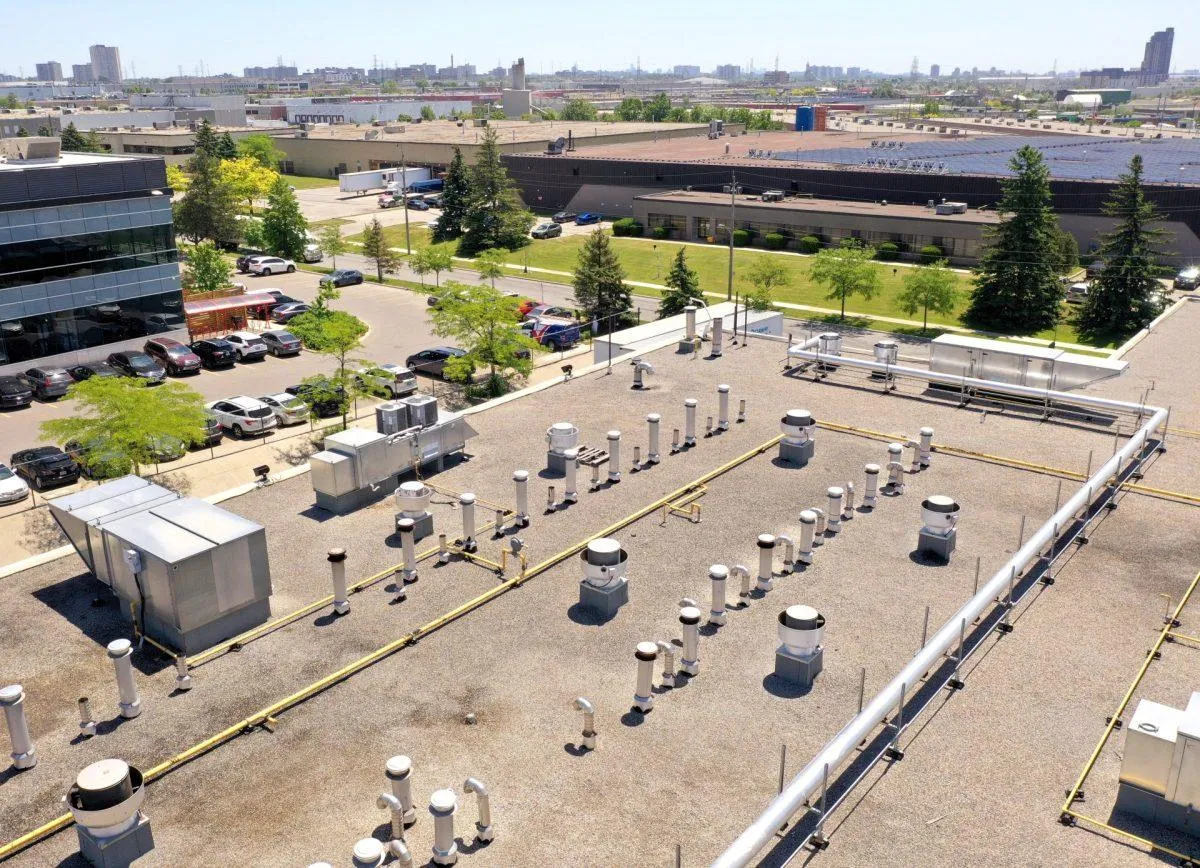
Food plants carry heavy rooftop loads: condensing units, evaporative equipment, large make-up air handlers, and refrigeration piping racks. We verify deck capacity and detail every equipment support so concentrated loads are not bearing on the membrane, and we route around piping racks with reinforced flashing rather than burying penetrations under equipment where they cannot be serviced. Drainage is designed with tapered insulation directing water to the drains, because intense local rainfall plus the thermal cost of ponding over cold rooms makes standing water a real operating problem here, not just a warranty footnote.
Working around production and sanitation windows
Processing plants here often run two or three shifts with a weekly sanitation window as the only time the production floor is quiet. Roofing work that opens the envelope over an active line has to fit those windows, with the QA manager confirming the floor is clean and protected before we start and after we finish. We phase the project around the production calendar, not the other way around. And because this is a Gulf Coast roof, every section we open is dried in watertight the same day. We do not leave a deck exposed over a production floor overnight, and we keep an emergency response line available for a leak over an active line, including priority dry-in and the documentation a plant needs for its incident reporting.
Are all roofing materials acceptable over food production areas?
No. Membranes, adhesives, primers, and sealants used over or near production space have to be confirmed acceptable against your food-safety plan, and that varies by product and manufacturer. We identify your regulatory framework and verify material acceptability with your QA team before specifying anything above food-contact zones.
Questions to settle early
Where is the risk?
Locate leaks, wet-insulation indicators, open seams, weak flashing, and drainage restrictions across the roof.
What can wait?
Separate immediate work from maintenance items that can be tracked for the next service window.
What should be funded?
Build a practical recommendation for repair, coating, recover, or replacement planning.
Need help with food processing roofing?
Send the building address, known roof age, access notes, and what changed. We will respond with the right next step.