
Drone & Thermal Roof Inspection for New Orleans Commercial Buildings, LA.
Drone & Thermal Roof Inspection for New Orleans Commercial Buildings, LA support in New Orleans, LA, with documented inspections, written scopes, and practical roof planning for commercial properties.
What this roof work solves
Drone & Thermal Roof Inspection for New Orleans Commercial Buildings, LA in New Orleans should begin with a documented roof walk. The first job is to identify active water entry, drainage problems, membrane condition, edge details, rooftop equipment conflicts, and weather exposure before a price or schedule is discussed.
For commercial owners, the useful answer is rarely a one-line recommendation. The roof file should explain the work area, the reason for the scope, the access constraints, and the next maintenance decision.
How the scope is built
The scope is based on service scope, building use, roof age, visible defects, and the cost difference between immediate repair and longer-range planning. When repair is enough, the work stays focused. When replacement or recover planning is the responsible move, the reasoning is written plainly.
Each finished project should leave behind before-and-after photos, service notes, and follow-up items so the owner keeps a record for future inspections, budgeting, and vendor conversations.
What an Aerial Survey Gives You That a Walk-Through Cannot
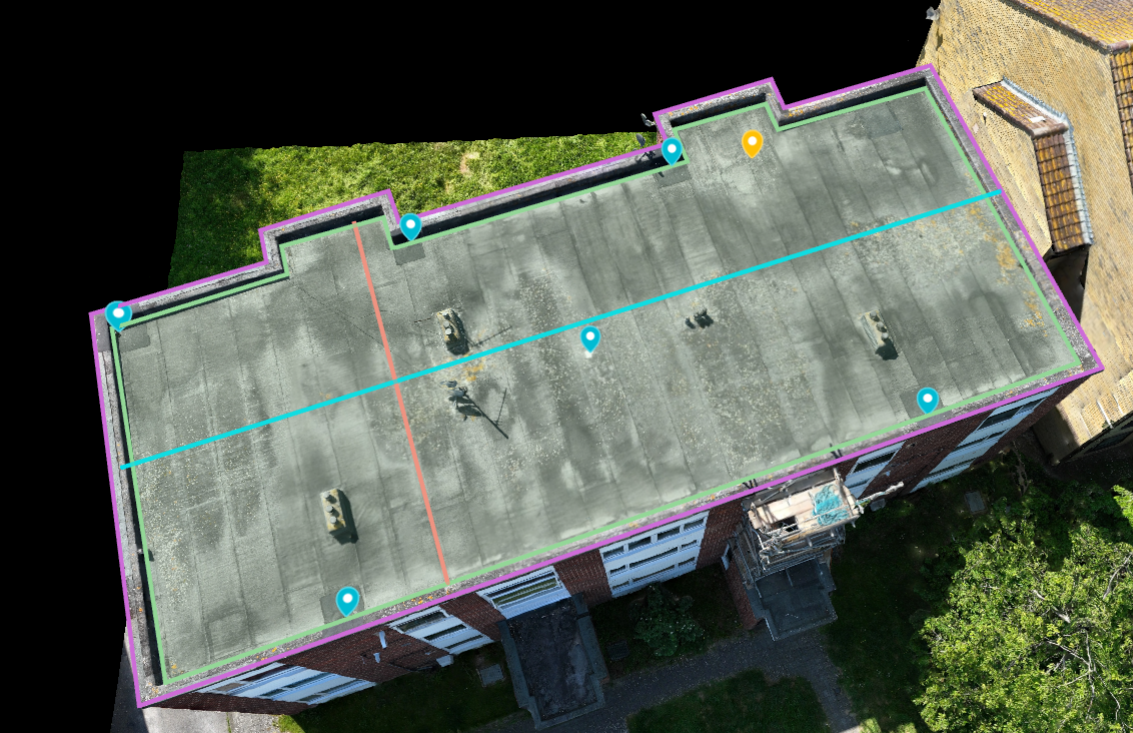
Picture the roof on a full-block warehouse near the Port of New Orleans or a regional distribution center out by Elmwood. An inspector on foot can cover a fraction of that surface in an hour, has to guess at the dead-flat ponding zones between drains, and leaves footprints across a membrane whose condition nobody has verified yet. A drone reverses every one of those limitations. It flies a programmed grid over the entire roof in one systematic pass, captures every seam, curb, drain basin, and penetration in high-resolution detail, and never touches the sheet. On the hundred-thousand-square-foot roofs that fill the industrial corridors of this city, that is the gap between a genuine condition report and a sample-and-extrapolate guess.
We fly before we ever stage a crew on the surface, and the reason is safety as much as data. On an aging or storm-hit roof, the soundness of the deck itself is an open question, and the old way of finding the soft spots was to send someone out to step on them. We would rather not. The aerial pass produces a complete visual record first, flags the areas that read as compromised, and lets us decide where a follow-up core cut is genuinely warranted instead of probing blind.
The Thermal Camera Finds the Expensive Problem
The single most valuable instrument the drone carries over a New Orleans roof is the infrared camera, because the costliest failure in this climate is moisture you cannot see from the surface. Water that migrates into the insulation below the membrane does not reliably announce itself with a ceiling stain. It sits in the insulation, strips the assembly of its R-value, and quietly corrodes the steel deck beneath while the top of the membrane still looks sound. Here is the physics we exploit: wet insulation holds the day's absorbed heat longer than the dry insulation around it. Flown during the cooldown window after sunset, the thermal camera renders those saturated zones as warm signatures glowing against a cooling field, because they shed their stored heat more slowly.
That infrared moisture map is the finding that steers the entire repair-or-replace decision. A handful of discrete warm spots ringed by dry membrane points to a targeted cut-and-patch. Warm signatures sprawling across a third of the roof point toward replacement, and the owner needs to know that before spending money chasing symptoms. New Orleans makes this distinction matter more than almost anywhere, because the constant upward vapor drive keeps pushing moisture into the assembly and the humid air rarely dries the roof back out. We confirm every thermal flag with a physical core cut before we write a scope: the camera tells us where to look, and the core tells us what is actually under the sheet.
The thermal contrast between wet and dry insulation lasts only a narrow window after sunset before the whole roof equalizes. A person cannot systematically sweep a hundred thousand square feet with a handheld imager inside that window without missing entire sections or stumbling across the membrane in the dark. The drone flies a consistent altitude over a fixed grid during exactly the period when the thermal signal peaks, and produces one continuous moisture map of the whole roof. That is simply not a capability a walking crew possesses, no matter how skilled.
Documentation Built for a Louisiana Claim
After a wind or hail event, the documentation is the claim. A New Orleans owner filing a commercial wind-damage claim, or working through a public adjuster, needs far more than a written statement that the roof took a hit. Drone imagery delivers GPS-tagged, time-stamped photographs of every damaged area keyed to its exact position on the roof, which is the format commercial adjusters already work from. We map hail-strike density across the field, document wind-displaced membrane and lifted edge metal, photograph damaged rooftop units and flashings, and assemble it into a package an adjuster can review remotely without ever climbing the building.
When Hurricane Ida moved through Orleans and Jefferson parishes in 2021, it set off a wave of contested roof claims, and the owners who came out ahead were the ones holding clean, georeferenced documentation captured right after the storm. We can fly a post-event inspection and turn around a claim-ready package within about a day of the flight, while the damage is fresh and before ordinary weathering blurs what the storm actually did. We produce the technical record; the owner or their adjuster carries it forward. We do not negotiate with carriers or act as adjusters, which is exactly what keeps the documentation clean and factual.
Putting a drone over a commercial building in New Orleans is regulated airspace work, not a recreational flight, and we run it that way. Operations fall under the FAA's Part 107 commercial rules, which govern pilot certification, altitude ceilings, and where and when a drone is permitted to fly. A large share of the metro sits beneath controlled airspace tied to Louis Armstrong International and the surrounding fields, which means some flights require airspace authorization before the aircraft leaves the case. We confirm the airspace class over your building, secure whatever authorization the location demands, hold visual line of sight throughout, and keep the aircraft clear of people below. For a roof near the riverfront or the denser parts of the metro, that planning is part of the work, and it is why this is a job for a certificated operator rather than anyone who happens to own a drone.
When the Drone Earns Its Place, and When It Does Not
- Large low-slope roofs above roughly ten thousand square feet, where a foot survey is slow and partial.
- Warehouse, logistics, and cold-storage buildings along the industrial corridors where roof area is enormous.
- Multi-building campuses and shopping centers that would take days to walk roof by roof.
- Post-storm claims that need to be captured fast and georeferenced for an adjuster.
- Suspected hidden saturation in the insulation that a surface walk has no way to detect.
- Pre-replacement surveys where accurate area, curb, and penetration locations cut change orders during construction.
On a small or steeply pitched roof, a conventional hands-on inspection is fast and thorough, and we will tell you so rather than flying for the sake of it. The drone proves its worth on the sprawling flat commercial roofs that define so much of the New Orleans building stock, where total coverage, thermal moisture mapping, and clean documentation are worth far more than what one inspector can gather on foot.
Questions to settle early
Where is the risk?
Locate leaks, wet-insulation indicators, open seams, weak flashing, and drainage restrictions across the roof.
What can wait?
Separate immediate work from maintenance items that can be tracked for the next service window.
What should be funded?
Build a practical recommendation for repair, coating, recover, or replacement planning.
Need help with drone & thermal roof inspection for new orleans commercial buildings, la?
Send the building address, known roof age, access notes, and what changed. We will respond with the right next step.