
Modified Bitumen Roofing — Installation and Recover.
Modified Bitumen Roofing — Installation and Recover support in New Orleans, LA, with documented inspections, written scopes, and practical roof planning for commercial properties.
What this roof work solves
Modified Bitumen Roofing — Installation and Recover in New Orleans should begin with a documented roof walk. The first job is to identify active water entry, drainage problems, membrane condition, edge details, rooftop equipment conflicts, and weather exposure before a price or schedule is discussed.
For commercial owners, the useful answer is rarely a one-line recommendation. The roof file should explain the work area, the reason for the scope, the access constraints, and the next maintenance decision.
How the scope is built
The scope is based on service scope, building use, roof age, visible defects, and the cost difference between immediate repair and longer-range planning. When repair is enough, the work stays focused. When replacement or recover planning is the responsible move, the reasoning is written plainly.
Each finished project should leave behind before-and-after photos, service notes, and follow-up items so the owner keeps a record for future inspections, budgeting, and vendor conversations.
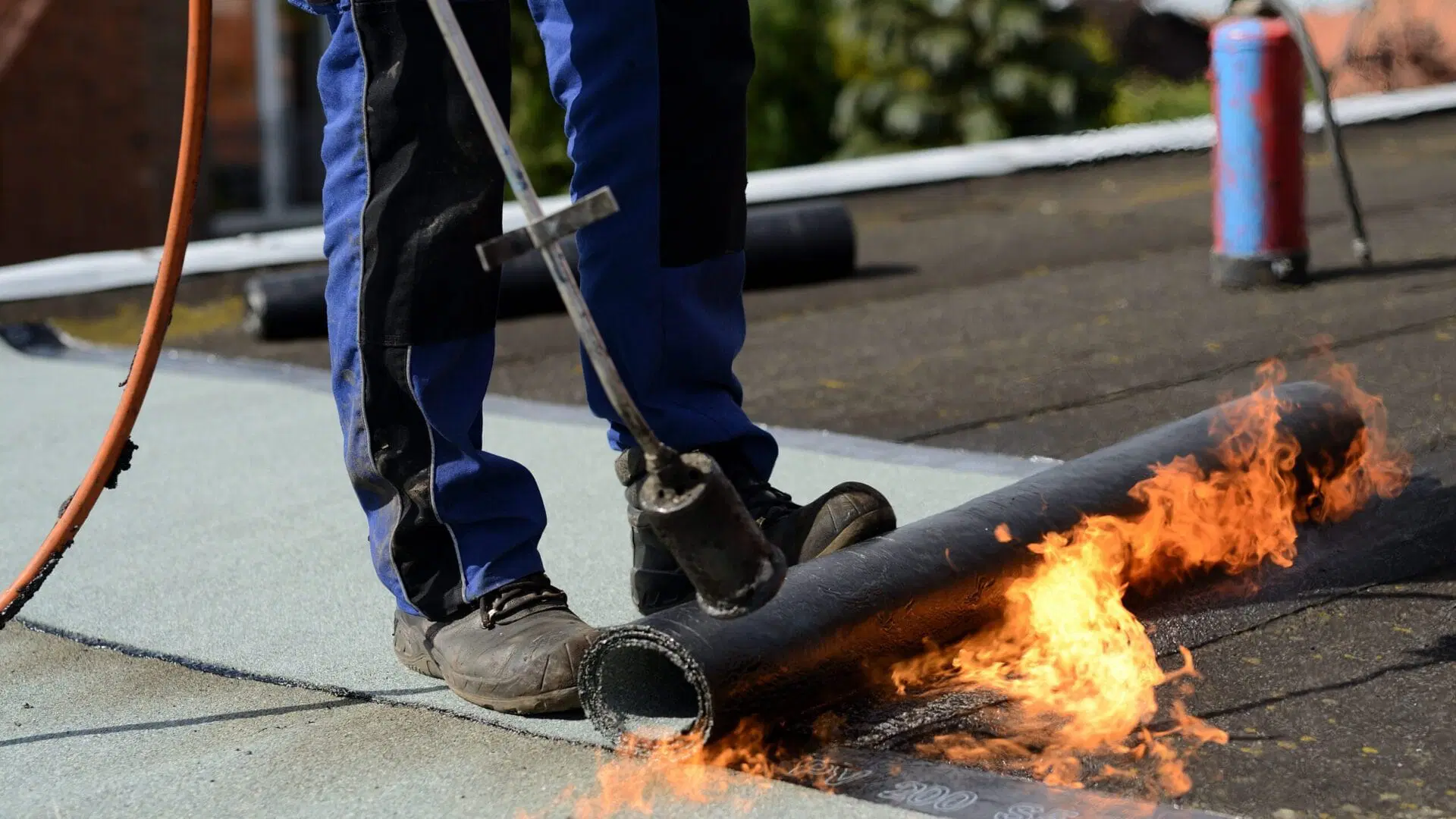
Torch-applied and self-adhered modified bitumen on qualifying New Orleans commercial recover and replacement projects — with straightforward guidance on where mod-bit is the right specification for this market and where single-ply is the better economic and performance choice.
Modified bitumen was the dominant commercial membrane on New Orleans commercial buildings through the late 1980s and 1990s — the French Quarter's hospitality buildings, the older retail corridors along Magazine Street and Veterans Boulevard in Metairie, and the smaller commercial buildings across the Uptown and Carrollton corridors were largely roofed in two-ply torch-down SBS systems during this period. Many of those systems survived Hurricane Katrina with varying degrees of damage and were repaired or recovered in the post-2005 rebuilding wave. The ones that were recovered rather than replaced are now approaching second-cycle replacement territory.
We install modified bitumen. We also tell building owners when TPO, PVC, or EPDM is a better economic and performance choice for their specific building. Mod-bit remains the right specification in certain New Orleans contexts — constrained-access historic buildings, roofs over existing BUR base plies, buildings where the hot-work permit process is manageable and the roof geometry suits a multi-ply application. On large-format warehouse buildings, roofs requiring 25-year warranty terms, or buildings that need cool-roof SRI compliance for the Louisiana energy code, single-ply is almost always the better choice.
Self-adhered cold-applied modified bitumen has become particularly relevant in New Orleans's medical and institutional market, where hot-work permits for occupied clinical buildings add lead time and operational disruption. Self-adhered systems eliminate the torch entirely while delivering comparable performance to torch-applied SBS — and they avoid the open-flame operation coordination that occupied healthcare buildings in the Tulane-Gravier district require.
Where Modified Bitumen Still Makes Sense in New Orleans
Recover over existing BUR on French Quarter and historic buildings: The French Quarter commercial inventory includes a significant number of pre-1970 buildings running original gravel-surface built-up roofing. Where Vieux Carré Commission review or building access constraints make full tear-off disruptive, a mod-bit recover — applying a new SBS granulated cap sheet over a leveling ply on the existing gravel BUR base — is often the most practical and cost-effective life extension when core pulls confirm dry insulation. This approach avoids full tear-off disposal in a historically constrained building environment.
Small and penetration-dense roofs: Modified bitumen's multi-ply nature handles complex penetration patterns more forgivingly than single-ply membranes on small commercial roofs. A Warehouse District restaurant building or a French Quarter retail building with dozens of penetrations — exhaust flues, conduit sleeves, rooftop equipment curbs — can be detailed in mod-bit without the custom-welded flashing components that each penetration requires in a TPO system. On roofs under 5,000 sq ft with high penetration density, mod-bit often produces a more reliable and faster installation.
Cold-storage and temperature-differential applications: Mod-bit's multi-ply structure is more tolerant of the vapor drive conditions created by significant temperature differentials between interior and exterior — relevant for cold-storage and refrigerated food-service buildings that exist in the New Orleans metro's food distribution and restaurant supply sector.
Where Single-Ply Has Eclipsed Modified Bitumen in the New Orleans Market
Large warehouse and distribution buildings: The eastern New Orleans warehouse and distribution corridor along Chef Menteur Highway and the Gentilly industrial zone runs large-footprint buildings where mechanically attached TPO or EPDM installs faster, carries equivalent warranty terms, and costs less per square than torch-down mod-bit. On roofs above 20,000 sq ft, single-ply is almost always the better capital decision.
Cool-roof and Louisiana energy code compliance: Louisiana's energy code requires minimum Solar Reflectance Index (SRI) compliance on new commercial roof installations. Standard granulated mod-bit cap sheet in gray or black runs SRI 0 to 20 — well below compliance threshold. White-granule mod-bit cap sheet is available and SRI-compliant but costs more than standard products and is less commonly stocked in the New Orleans market. Standard white TPO achieves SRI 78 to 104 and is code-compliant without supplemental specification.
Hurricane-season warranty term requirements: The maximum standard manufacturer warranty on modified bitumen from major manufacturers is 20 years, with many programs capping at 15 years. TPO and PVC carry 20 and 25-year NDL paths. For building owners in the New Orleans market who are making a post-storm replacement investment and want the longest warranty protection available, single-ply wins on warranty term.
Torch-Down vs. Self-Adhered in the New Orleans Context
Torch-applied SBS is the standard production method for most commercial mod-bit work — faster installation and typically lower material cost than self-adhered systems. Hot-work permits are required for torch-applied work in New Orleans and Jefferson Parish jurisdictions. The City of New Orleans permit process and Jefferson Parish's inspection office both handle hot-work permit requests on predictable timelines, but the process adds project lead time.
Questions to settle early
Where is the risk?
Locate leaks, wet-insulation indicators, open seams, weak flashing, and drainage restrictions across the roof.
What can wait?
Separate immediate work from maintenance items that can be tracked for the next service window.
What should be funded?
Build a practical recommendation for repair, coating, recover, or replacement planning.
Need help with modified bitumen roofing — installation and recover?
Send the building address, known roof age, access notes, and what changed. We will respond with the right next step.