
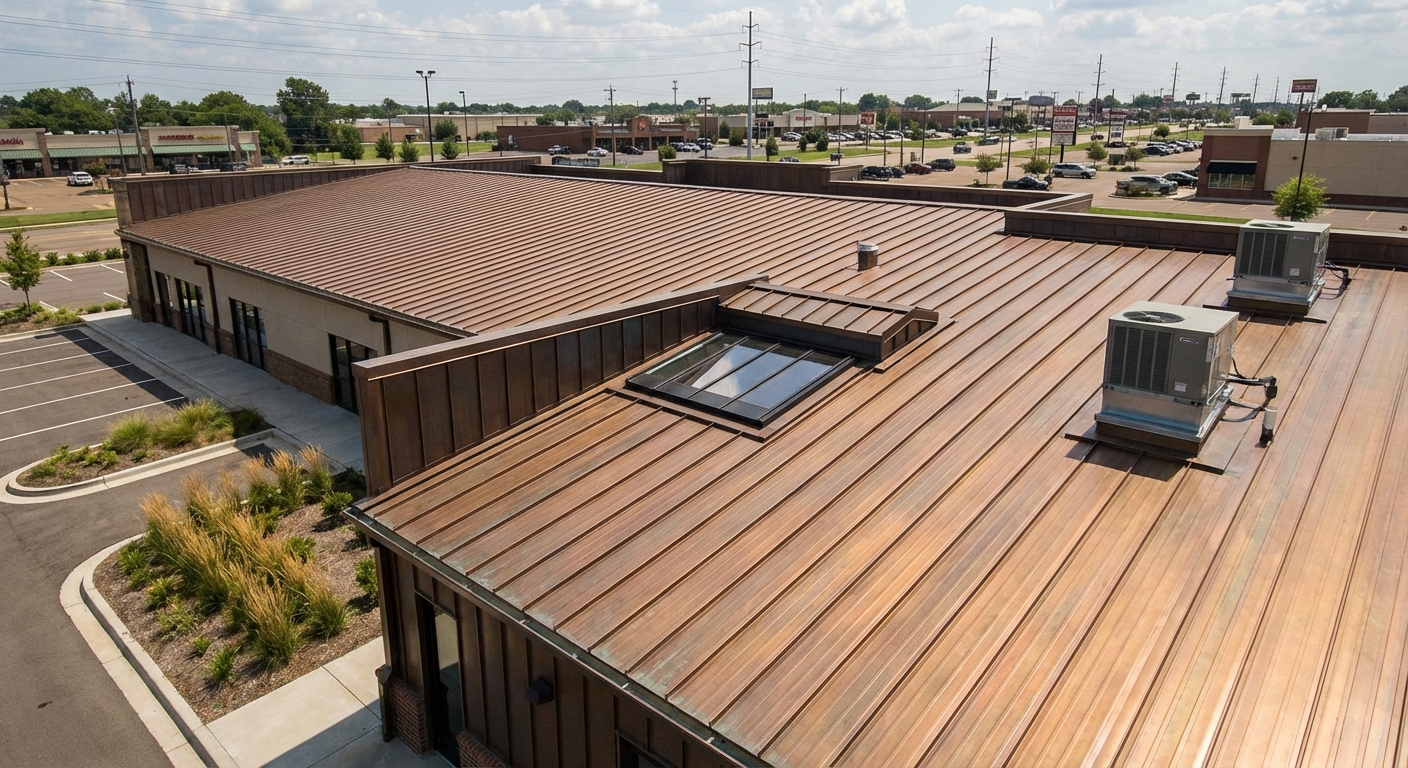
Standing Seam Metal Roofing.
Standing Seam Metal Roofing support in New Orleans, LA, with documented inspections, written scopes, and practical roof planning for commercial properties.
What this roof work solves
Standing Seam Metal Roofing in New Orleans should begin with a documented roof walk. The first job is to identify active water entry, drainage problems, membrane condition, edge details, rooftop equipment conflicts, and weather exposure before a price or schedule is discussed.
For commercial owners, the useful answer is rarely a one-line recommendation. The roof file should explain the work area, the reason for the scope, the access constraints, and the next maintenance decision.
How the scope is built
The scope is based on service scope, building use, roof age, visible defects, and the cost difference between immediate repair and longer-range planning. When repair is enough, the work stays focused. When replacement or recover planning is the responsible move, the reasoning is written plainly.
Each finished project should leave behind before-and-after photos, service notes, and follow-up items so the owner keeps a record for future inspections, budgeting, and vendor conversations.
Standing seam metal roofing on New Orleans commercial buildings carries a unique set of requirements that inland markets do not face: hurricane wind-uplift engineering, humid subtropical corrosion resistance, and in certain historic districts, Vieux Carré Commission review of visible rooftop materials. We scope, install, and close out standing seam to all three demands.
Standing seam metal roofing has been showing up on New Orleans commercial projects in two distinct contexts. The first is historic district adaptive reuse: the Warehouse District's gallery and loft conversions, the Frenchmen Street entertainment corridor, and the Magazine Street commercial strip have all seen standing seam integrated into renovation projects where the exposed panel profile reads as a design choice rather than utilitarian cladding. The second context is new construction in the lakefront and New Orleans East warehouse corridors, where the building's capital horizon is long enough that the lifecycle math on a properly engineered standing seam system — higher upfront, dramatically reduced reroof frequency — competes favorably against single-ply alternatives even at Gulf Coast installation costs.
We install standing seam in both contexts. Every project we run is scoped against the building's slope, structural capacity, thermal movement characteristics, and the Gulf Coast environment — because standing seam in New Orleans faces corrosion and moisture challenges that a system installed in a drier inland market would not encounter. Panel substrate selection, clip system design, and flashing details are all calibrated to the humid subtropical conditions that New Orleans records ten months out of twelve.
The two specification decisions that drive most commercial standing seam projects are finish selection and seam type. Both decisions interact with the building's slope, span, and wind-uplift requirements under ASCE 7 hurricane-prone region classification. We walk through those decisions systematically with every client before any material is ordered, and we document the design rationale in the project file.
Galvalume vs. Painted Finish in a Gulf Coast Environment
Galvalume — a zinc-aluminum alloy coating bonded to the steel substrate — provides the foundation durability standard for commercial standing seam in any climate. In New Orleans's salt-air and high-humidity environment, the corrosion resistance of the alloy coating matters more than it would in a drier inland market. Galvalume carries a 40-year substrate warranty from major manufacturers, and the zinc-aluminum chemistry specifically resists the sulfur-compound and chloride exposure that coastal markets generate. If the building does not require a color statement and sits outside the historic overlay districts, Galvalume is the honest long-term specification for the Gulf Coast context.
Kynar 500 or 70%-PVDF painted finishes add color flexibility and architectural identity. These finishes dominate the Warehouse District and Magazine Street commercial projects where the metal system is part of the building's visual presentation — dark bronze and weathered-steel tones have become a signature of that corridor's renovation aesthetic. Kynar finishes carry a 40-year substrate warranty and a separate 30-year color, chalk, and fade warranty from major manufacturers. They cost more per square than Galvalume but require no repainting over the system's life.
A consideration specific to New Orleans: white and light-gray Kynar finishes qualify for Cool Roof Rating Council ratings that support ASHRAE 90.1 and Louisiana's energy code compliance requirements in Climate Zone 2A. The energy savings from a reflective standing seam surface on a New Orleans commercial building in July and August are meaningful — surface temperatures on dark metal panels in this market can exceed 175°F, which adds measurable HVAC load. We specify the CRRC-rated option when the project needs energy code documentation.
Snap-Lock vs. Mechanical Seam on Gulf Coast Buildings
Snap-lock panels interlock at the seam without a powered seaming tool, making them faster to install and less expensive in labor cost per square. They are the appropriate choice for slopes above 3:12 where the panel geometry allows free drainage and the seam is not subject to standing-water pressure. Most of the commercial standing seam we install on sloped buildings in the Garden District commercial corridor and the Frenchmen Street area runs snap-lock on the pitched sections.
Mechanical seam panels are crimped to 180° or 360° after installation using a powered seaming tool. The resulting double-lock seam holds its water barrier under sustained standing-water conditions at slopes down to 1:12 — the range where most New Orleans commercial flat-to-low-slope standing seam applications live. Any standing seam project on a New Orleans building with a roof slope below 3:12 should specify mechanical seam without exception. Snap-lock below 3:12 in a market that receives over 60 inches of annual rainfall is a failure that happens in the first major rain event.
Thermal movement in New Orleans's climate follows a different pattern than northern or high-desert markets: the temperature differential between a July afternoon and a January overnight is smaller than in a continental climate, but the sustained high-temperature exposure is longer, and the humidity accelerates oxidation at clip interfaces that are under-specified. We design the clip pattern to the manufacturer's published thermal-movement allowance for the specific panel, and we specify stainless-steel clips on projects near the lakefront or in direct salt-air exposure zones.
Hurricane Wind-Uplift and Historic District Requirements
New Orleans stands in ASCE 7 hurricane-prone region territory. Standing seam's advantage in this environment is that the concealed-clip attachment system, when engineered correctly, distributes wind-uplift load across the full panel length rather than concentrating it at point fasteners. We document the clip spacing and pull-out calculation in every project closeout file — the manufacturer's structural design software, using the building's actual dimensions, exposure category, and occupancy classification, drives the clip pattern rather than a generic table.
Questions to settle early
Where is the risk?
Locate leaks, wet-insulation indicators, open seams, weak flashing, and drainage restrictions across the roof.
What can wait?
Separate immediate work from maintenance items that can be tracked for the next service window.
What should be funded?
Build a practical recommendation for repair, coating, recover, or replacement planning.
Need help with standing seam metal roofing?
Send the building address, known roof age, access notes, and what changed. We will respond with the right next step.