Infrared Roof Scanning.
Infrared Roof Scanning support in New Orleans, LA, with documented inspections, written scopes, and practical roof planning for commercial properties.
What this roof work solves
Infrared Roof Scanning in New Orleans should begin with a documented roof walk. The first job is to identify active water entry, drainage problems, membrane condition, edge details, rooftop equipment conflicts, and weather exposure before a price or schedule is discussed.
For commercial owners, the useful answer is rarely a one-line recommendation. The roof file should explain the work area, the reason for the scope, the access constraints, and the next maintenance decision.
How the scope is built
The scope is tuned to owner documentation, building use, roof age, visible defects, and the cost difference between immediate repair and longer-range planning. When repair is enough, the work stays focused. When replacement or recover planning is the responsible move, the reasoning is written plainly.
Each finished project should leave behind before-and-after photos, service notes, and follow-up items so the owner keeps a record for future inspections, budgeting, and vendor conversations.
Infrared thermography in a subtropical climate operates inside a narrower seasonal window than the tool's general reputation implies. New Orleans's high dew points, slow-cooling summer nights, and frequent post-rain membrane surface moisture all constrain when IR produces a usable result. We use IR where it works and tell you when it does not.
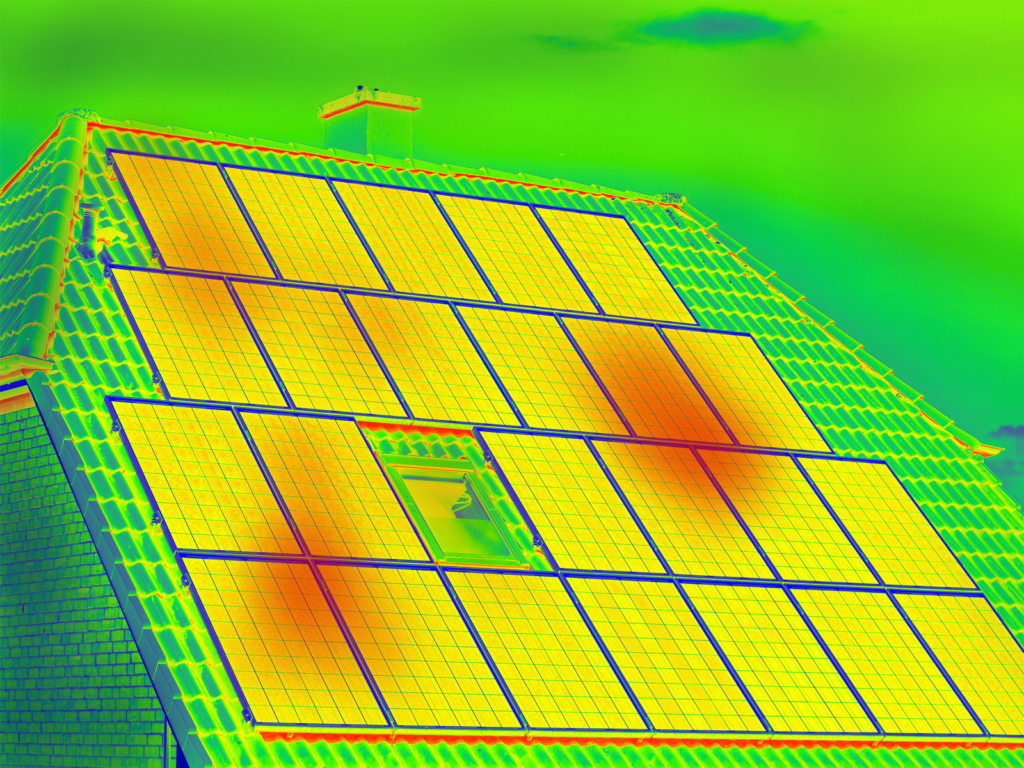
Infrared scanning for commercial roofing works on a specific physical principle: wet insulation retains heat longer than dry insulation after solar loading ends. A thermal camera scanning the roof surface two to four hours after sunset detects the wet zones as warmer anomalies against the cooling dry field. It is a powerful coverage tool for large roofs — a 100,000 square foot building that would require 35 to 40 core pulls for a full-coverage grid survey can be scanned in a single evening, and the thermogram narrows the core sampling to the probable wet zones for confirmation.
New Orleans's subtropical climate creates specific constraints on when that principle produces a usable result. Summer nights in July and August cool slowly. The roof surface retains heat from the 150°F daytime peak for hours after sunset because the ambient air temperature is still in the low-to-mid 80s at 10 PM, and the dew point is in the upper 70s. The temperature differential between wet and dry zones — the signal the camera is reading — is suppressed. The thermogram is ambiguous. Trying to make a capital decision from a mid-summer New Orleans thermogram is not a sound practice.
The post-hurricane-season fall window — late October through January — is when New Orleans IR conditions are most favorable. Daytime solar loading is still sufficient to charge the insulation and membrane. Evening temperatures drop faster as cold fronts push through. The differential between wet and dry zones becomes readable. We schedule IR surveys in this window and assess conditions for each specific site before committing to the scan date.
The New Orleans IR Season — What Works and What Does Not
Conditions that produce usable thermograms in the New Orleans market: at least four hours of direct solar loading during the day with no significant cloud cover, a temperature differential of 15 to 20°F or more between the roof surface and the ambient air at scan time, dew point below the point where condensation begins to form on the membrane surface before the scan is complete, no precipitation in the prior 48 hours — rain leaves the membrane surface uniformly wet and creates false-positive anomalies across the field — and no significant wind above 15 miles per hour, which equalizes surface temperatures and suppresses anomaly contrast.
The New Orleans-specific constraint that matters most is dew point. The metro routinely records dew points above 75°F from May through September. At those dew point levels, as a roof surface cools in the evening, dew begins condensing on the membrane surface before the thermal differential between wet and dry insulation zones is fully developed. The dew creates uniform surface moisture that the camera reads as a false signal across the entire field. This condition is much less common in October through January, when frontal systems periodically drop dew points below 60°F and create the low-humidity evenings that produce clean thermograms.
White and light-gray TPO and PVC membranes — common on New Orleans commercial buildings installed for energy-code compliance — absorb less solar energy than dark membranes and produce a weaker IR signal. For highly reflective membrane surfaces in the New Orleans market, core sampling at strategic density often produces more reliable data than IR at lower overall cost. We assess this trade-off for each building before recommending the scan.
How IR Combines With Core Sampling on New Orleans Roofs
The IR scan produces a thermogram with warm anomaly zones marked as probable moisture locations. We pull cores at each significant anomaly zone to confirm the finding — wet, damp, or dry. We also pull cores in several zones the thermogram reads as dry to confirm the IR baseline is accurate on that building. Buildings with post-Katrina construction patterns that concentrate moisture at drains and parapet bases often have the IR-confirmed zones match the high-probability locations we would have targeted anyway — in those cases, IR adds the coverage confirmation that our targeted core pulls are not missing a distributed wet zone elsewhere on the roof.
For large-footprint buildings in the New Orleans market — the warehouse and distribution buildings along the river corridor and in New Orleans East, the large retail anchors in Jefferson Parish, and the hospital and medical campus buildings that house equipment-critical operations — the IR-plus-core combination produces the highest confidence at the lowest membrane disruption. Full-coverage core grids on a 150,000 square foot building are expensive and disruptive. IR narrows the sample to confirmed zones, reducing the core count while maintaining confidence that significant wet areas are not being missed.
The combined deliverable — thermogram mosaic, annotated anomaly map, core confirmation results keyed to the same zone diagram, and moisture distribution summary — integrates into the condition report as an addendum rather than a separate standalone document. The moisture findings are part of the full condition record, not a separate survey.
After a storm event, IR scanning is complicated by the same conditions that make post-storm roof access complicated generally — standing water on the membrane surface, residual rain events in the days after the storm, and membrane surface moisture from the storm itself that reads as a false-positive field across the entire thermogram. We do not rush IR scanning onto storm-damaged buildings in the immediate post-storm period when surface moisture has not had time to dissipate.
For post-storm moisture assessment where timing matters — where the owner needs to know the insulation condition quickly to make an emergency scope decision — core sampling is the faster and more reliable tool. Core pulling can be done under almost any conditions that allow roof access. We often use core sampling for the immediate post-storm moisture assessment and follow with IR scanning in the subsequent October-November window if the building is a recover candidate and the IR conditions are favorable by then.
Questions to settle early
Where is the risk?
Locate leaks, wet-insulation indicators, open seams, weak flashing, and drainage restrictions across the roof.
What can wait?
Separate immediate work from maintenance items that can be tracked for the next service window.
What should be funded?
Build a practical recommendation for repair, coating, recover, or replacement planning.
Need help with infrared roof scanning?
Send the building address, known roof age, access notes, and what changed. We will respond with the right next step.