
Water Damage Roof Repair.
Water Damage Roof Repair support in New Orleans, LA, with documented inspections, written scopes, and practical roof planning for commercial properties.
What this roof work solves
Water Damage Roof Repair in New Orleans should begin with a documented roof walk. The first job is to identify active water entry, drainage problems, membrane condition, edge details, rooftop equipment conflicts, and weather exposure before a price or schedule is discussed.
For commercial owners, the useful answer is rarely a one-line recommendation. The roof file should explain the work area, the reason for the scope, the access constraints, and the next maintenance decision.
How the scope is built
The scope is geared to damage response, building use, roof age, visible defects, and the cost difference between immediate repair and longer-range planning. When repair is enough, the work stays focused. When replacement or recover planning is the responsible move, the reasoning is written plainly.
Each finished project should leave behind before-and-after photos, service notes, and follow-up items so the owner keeps a record for future inspections, budgeting, and vendor conversations.
No US metro puts more cumulative water volume through commercial flat roofs per year than New Orleans. Sixty-plus inches of annual rainfall, subtropical humidity that prevents drying between events, and hurricane-season rain bands that deliver inches per hour — water damage on New Orleans commercial roofs is not an edge case. It is the baseline condition we manage.
Water damage on a New Orleans commercial flat roof is a cascade problem, not a single-event problem. It begins with a breach — seam failure, penetration flashing deterioration, storm-caused membrane compromise — and then progresses through the insulation layer in a subtropical climate that never allows the assembly to fully dry between rain events. By the time interior ceiling staining appears, the moisture damage in the insulation has typically been present for weeks or months and extends well beyond the visible stain area.
Hurricane Ida's August 2021 track through Jefferson and Orleans parishes deposited 15 inches of rainfall across the metro in 48 hours while simultaneously producing Cat-4 wind damage that compromised membrane edges and parapet flashings on commercial buildings across Metairie, Kenner, Gentilly, and New Orleans East. The water damage that followed Ida's wind damage was in many cases more costly than the wind damage itself — sustained moisture infiltration through wind-compromised roof envelopes in August's 80-percent humidity produced mold and air-quality issues within two weeks of the storm.
We assess, document, and repair water damage from both storm-event and chronic-infiltration sources. For storm-related water damage, we produce documentation in the format Louisiana insurance carriers and adjusters require. For chronic water damage from maintenance-related failure, we produce the scope and the repair — with the pre-existing condition documentation that separates our work from whatever storm claims may come later.
Saturated Insulation in the Subtropical Climate
The most destructive form of water damage on New Orleans commercial flat roofs is not the active drip — it is the saturated insulation layer that never dries. Polyiso and expanded polystyrene insulation in a subtropical climate can retain water in the cell structure for months between rain events once moisture has penetrated the membrane surface. Saturated insulation in a flat-roof assembly in this market adds structural load to the membrane and deck, accelerates corrosion on light-gauge metal deck substrates, and supports biological growth that further degrades the membrane adhesion.
Moisture core sampling is the diagnostic tool for identifying saturated insulation beneath intact-looking membrane surfaces. We pull cores at drain pans, parapet corners, mid-field locations, and anywhere a facility manager has flagged recurring ceiling stains — the locations most likely to show early saturation. In the New Orleans market, we consider insulation with moisture content above 15 percent a replacement candidate rather than a dry-in candidate, because drying saturated polyiso in 75-plus percent ambient humidity is not a reliable remediation strategy.
The moisture core map becomes the foundation of the repair scope: dry areas get surface repairs where the membrane breach is identifiable, and wet areas get insulation replacement plus membrane repair or recover. For large commercial buildings with widespread saturation, the moisture core map also becomes the basis for the replacement recommendation when the wet footprint exceeds 25 percent of the roof area.
Flat-Roof Ponding and Drainage in New Orleans
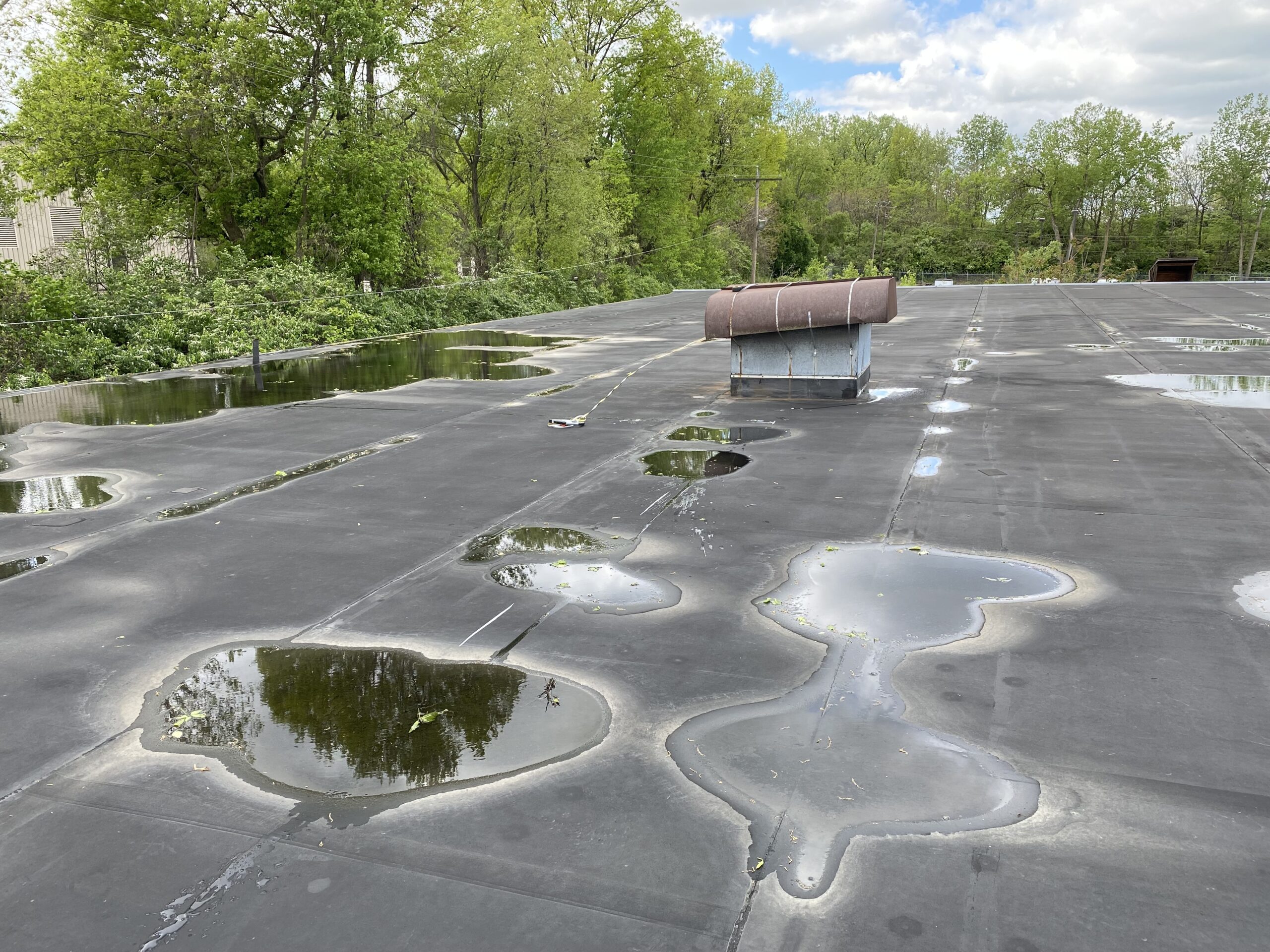
Ponding water on a New Orleans commercial flat roof is not a cosmetic issue — it is an accelerated aging condition in a climate where summer surface temperatures on dark membranes exceed 150°F. Water pooled on a commercial roof membrane in a subtropical environment promotes biological growth, accelerates membrane oxidation, and increases the membrane's thermal cycling stress as the pond heats and cools through daily temperature swings. Most single-ply membrane warranties have a maximum ponding threshold of 48 hours — a threshold routinely exceeded on low-slope Orleans Parish commercial buildings with inadequate slope-to-drain.
New Orleans's Sewerage and Water Board drainage infrastructure was substantially upgraded after Katrina, but roof drainage capacity on individual buildings remains a critical specification item. Peak rainfall intensity during tropical weather events exceeds three inches per hour — significantly above the design standard for most commercial roof drain systems installed on older buildings in the metro. We specify tapered insulation systems on water-damage repair and replacement projects where existing drain placement is suboptimal, and we document slope-to-drain confirmation in every repair closeout.
Post-storm drain clearing is a standard first response on every commercial building we assess after a Gulf weather event. Oak debris, wind-blown material, and biological growth concentrated at drain bowls are the most common cause of post-storm ponding on buildings that otherwise have adequate drainage slope. We confirm drain flow with a water test after every clearing and photograph the confirmed drain-open condition in the closeout record.
Water Damage Documentation for Louisiana Carriers
Storm-related water damage on a commercial building in New Orleans requires a documentation package that separates the storm-caused infiltration points from any pre-existing water damage conditions. Louisiana insurance carriers — including Louisiana Citizens, State Farm, Allstate, and USAA — work within a regulatory environment shaped by the post-Katrina claim-handling reforms that the Louisiana Department of Insurance implemented after 2005. Those reforms require clear attribution of storm-caused damage versus pre-existing conditions.
Questions to settle early
Where is the risk?
Locate leaks, wet-insulation indicators, open seams, weak flashing, and drainage restrictions across the roof.
What can wait?
Separate immediate work from maintenance items that can be tracked for the next service window.
What should be funded?
Build a practical recommendation for repair, coating, recover, or replacement planning.
Need help with water damage roof repair?
Send the building address, known roof age, access notes, and what changed. We will respond with the right next step.